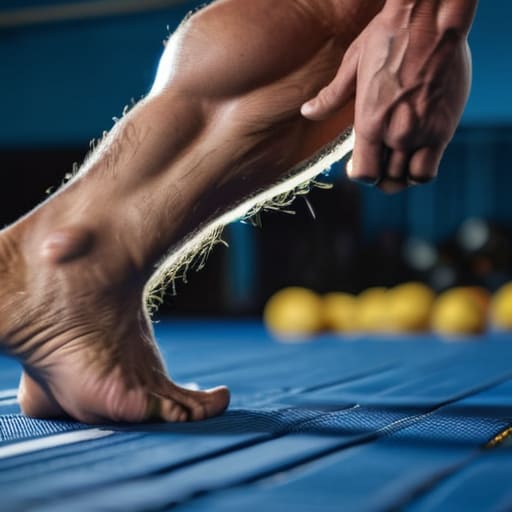
I remember sitting on the edge of a sweat-soaked mat in a basement gym during my early twenties, nursing a bruised hip and wondering why I kept getting snapped down like a ragdoll. I had the strength, I had the conditioning, but every time my opponent changed levels, I felt like my body was a half-second behind the movement. It wasn’t a lack of power; it was a failure of wrestling-specific proprioception. I was strong on paper, but on the mat, I was clumsy and reactive instead of intuitive and dominant.
I’m not here to sell you some overpriced, high-tech balance board or a complicated neurological protocol that takes an hour to set up. We’re going to cut through the academic fluff and focus on how you actually build that “mat sense” through functional, gritty movement. My promise to you is simple: I’m going to show you how to train your nervous system to anticipate the chaos, ensuring your body knows exactly where it is in space before your opponent even makes their move.
Table of Contents
Developing Kinesthetic Awareness in Grappling for Total Control

When you’re deep in a scramble, you don’t have time to think about where your limbs are; your body just has to know. This is where developing true kinesthetic awareness in grappling becomes the difference between a clean escape and getting pinned. It’s about more than just being “flexible.” It’s about your brain receiving constant, accurate data from your joints while you’re under pressure. If you can’t feel your hips shifting while an opponent is trying to break your posture, you’ve already lost the exchange.
To get there, we have to move beyond basic lifting and incorporate mat-based stability drills that actually mimic the chaos of a match. I’m talking about single-leg holds on unstable surfaces or reacting to unexpected weight shifts from a partner. We aren’t just building muscle here; we are training your nervous system to process combat sports sensory feedback in real-time. When you sharpen that connection between your brain and your muscles, you aren’t just reacting to your opponent—you’re anticipating them.
Building Joint Position Sense in Wrestling to Command the Mat

When you’re deep in a scramble, you don’t have time to think about where your limbs are. You just react. This is where joint position sense in wrestling becomes your biggest advantage. It’s that subconscious ability to know exactly how your knee is angled or how much tension is in your wrist without needing to look. If your brain is lagging on that data, you’re either going to lose the position or, worse, end up with a preventable injury.
To sharpen this, I move away from static stretching and toward mat-based stability drills that force the body to adapt to chaos. I’m talking about single-leg holds on unstable surfaces or practicing shoot entries while maintaining contact with a resisting partner. You want to create high-quality combat sports sensory feedback by constantly challenging your body to find center in awkward, non-linear movements. We aren’t just training muscles here; we are training the nervous system to map out your body’s geometry under pressure. That’s how you turn a frantic scramble into a controlled, dominant position.
5 Ways to Sharpen Your Mat Sense
- Stop relying on your eyes and start trusting your touch. Spend time doing drilling drills where you focus entirely on the tension in your opponent’s limbs; learning to “feel” their weight shift before they actually move is what separates a technician from someone just reacting to chaos.
- Incorporate single-leg stability work into your lifting sessions. If you can’t maintain balance on one leg while holding a heavy kettlebell, you’re going to get snapped down the second you shoot for a single-leg takedown.
- Train on unstable surfaces, but don’t overdo it. Using a Bosu ball or an uneven foam pad for your strength work isn’t about building bigger muscles—it’s about teaching your nervous system to micro-adjust your joints so you don’t get caught off balance during a scramble.
- Slow down your technical drilling. It’s tempting to go at 100% speed, but if you want to build real kinesthetic awareness, you need to move through your shots and transitions at half-speed to actually feel the alignment of your hips and the placement of your feet.
- Use reactive agility drills to bridge the gap between the weight room and the mat. You can have all the strength in the world, but if your brain can’t process a sudden change in direction or a snap-down, that strength is useless. Get your feet moving in ways that force your body to react, not just follow a pattern.
The Bottom Line: Training for Mat Awareness
Stop treating proprioception like an abstract concept; it’s a physical skill that requires intentional, unstable training to master.
Focus on joint position sense during your lifting sessions so your body knows exactly where it is when you’re scrambling in a match.
Consistency is your best tool—you can’t expect to have elite spatial awareness on the mat if you aren’t building that neuromuscular connection in the gym.
The Invisible Edge
“In a scramble, you don’t have time to think about where your limbs are or how your weight is shifting—you have to train your body to know it instinctively. Proprioception isn’t some abstract science concept; it’s the difference between being the one controlling the tie-up and the one getting snapped down because you lost your center.”
Tamsin Broadhurst
The Path to Mat Mastery
At the end of the day, mastering proprioception isn’t about memorizing a bunch of complex drills or hoping you have a “good day” on the mats. It’s about the intentional work you do between the whistles—training your brain to recognize joint positions, refining your kinesthetic awareness, and teaching your body to react without needing to think first. When you bridge the gap between your physical strength and your neuromuscular control, you stop reacting to your opponent and start dictating the pace of the match. It’s the difference between being a powerful athlete and being a truly capable wrestler who can maintain dominance even when the scramble gets chaotic.
Don’t get discouraged if you feel clunky or uncoordinated when you first start implementing these specific training protocols. Strength and spatial awareness are skills, and like any skill, they require relentless consistency to sharpen. You aren’t just training to win a single match; you are building a body that is resilient, intuitive, and ready for whatever comes through the center circle. Keep showing up, keep fueling your movement, and trust the process. You are building a foundation that will serve you long after you step off the mat. Go get after it.
Frequently Asked Questions
How can I tell if my proprioception is actually lagging behind my strength during a live match?
You’ll know it’s lagging when you feel “strong but clumsy.” If you’re winning the hand fight and have the explosive power to drive through a shot, but you’re constantly getting caught in scrambles or losing your footing during a transition, that’s a proprioception gap. Your muscles can generate the force, but your brain isn’t mapping your body’s position fast enough to apply it. You’re essentially a high-horsepower engine stuck in a car with bad steering.
Are there specific drills I can do at home without a wrestling partner to help sharpen my body awareness?
You don’t need a partner to start sharpening your internal GPS. Try practicing single-leg Romanian deadlifts with slow, controlled tempos—it forces your stabilizing muscles to react to every micro-shift. I also swear by “eyes-closed” balance work; standing on one leg and closing your eyes strips away visual cues, making your nervous system work overtime to find center. It’s about teaching your brain to listen to your joints, even when no one’s pushing you.
Does training heavy lifts actually help my mat awareness, or should I be focusing more on balance-based movements?
It’s not an “either/or” situation—it’s both. Heavy lifting builds the structural integrity and force production you need to hold a position, but balance drills teach you how to use that strength when things get chaotic. If you’re only doing stability work, you’ll lack the power to finish a takedown. If you’re only lifting heavy, you’ll be too rigid on the mat. Use the big lifts to build the engine, then use proprioceptive training to learn how to drive it.
